Planr Is Live: A Better Way to Turn Ideas Into Action
Starting something is easy. Turning an idea into a plan that fits your life, adapting it when things change, and actually finishing it is much harder.
Mohieb Al-Hesan6 min read
On this page
Starting something new is exciting. It could be a side project, a small business, a university project, learning a new skill, getting in shape, writing a book, or moving somewhere new. The idea itself is usually the easy part because, at that stage, you can see the possibilities and imagine where you want to end up without having to deal with everything standing between you and that outcome.
Then you try to turn the idea into something real.
Suddenly, there are questions everywhere. What should you do first? How much time will everything take? What are you missing? Is the goal actually realistic given your circumstances? And what happens when things inevitably don't go according to plan?
That's the gap Planr is built around.
The gap between wanting and doing
Most people don't struggle because they don't have enough things they want to accomplish. The problem is often the opposite: there are too many things they want to do, and an overwhelming amount of information telling them how to do them.
There are articles to read, videos to watch, courses to take, ideas to explore, tools to try, and plans to follow. With so much information available, starting something can seem easier than ever. But turning all of that information into something that actually works for one particular person is much harder.
A plan that worked for someone else might assume they have twenty hours a week available, while you have five. It might depend on experience, money, connections, or resources that you don't have. It might have worked perfectly within their circumstances and be completely unrealistic within yours.
Even a great plan can be the wrong plan for you.
Planning shouldn't start with a checklist
A checklist can tell you what someone thinks you should do. It doesn't necessarily tell you what you should do.
A useful plan needs context. It needs to understand how much time you actually have, what responsibilities are already competing for that time, what you've tried before, what resources you have, what constraints you're working with, and what matters most to you.
Without that context, even a highly detailed plan can become just another thing you have to manage.
Planr starts from the other direction. Instead of giving you a predefined plan, it starts with what you're actually trying to accomplish and works with you to understand what that goal means within the context of your life.
It can ask about your situation, your available time, your commitments, your previous attempts, and your priorities. From there, it can turn a messy idea into something concrete: milestones, tasks, priorities, and a path you can actually start following.
Your circumstances matter
Personalization is at the heart of Planr because two people can have exactly the same goal and still need completely different plans.
Someone with twenty hours a week available doesn't need the same roadmap as someone with five. Someone who has already tried and failed several times doesn't necessarily need to start from the same place as someone doing it for the first time.
A good plan shouldn't only describe the destination. It should take into account the person trying to get there.
That's why Planr considers things like your available time, commitments, constraints, experience, previous attempts, and priorities when shaping a plan.
The objective isn't necessarily to find the fastest theoretical way to accomplish something. It's to find a path that makes sense within the life you're actually living.
Plans need to survive reality
Creating the plan is only the beginning. The real test starts when you try to follow it.
Something takes longer than expected. A supplier doesn't work out. Work gets busy. Your priorities change. You discover that one of your assumptions was wrong. These things don't necessarily mean that the goal has failed; they mean that the circumstances have changed.
The problem is that traditional planning often treats the plan as something fixed. Once the original plan stops working, you're left with an outdated checklist and the feeling that you're falling behind.
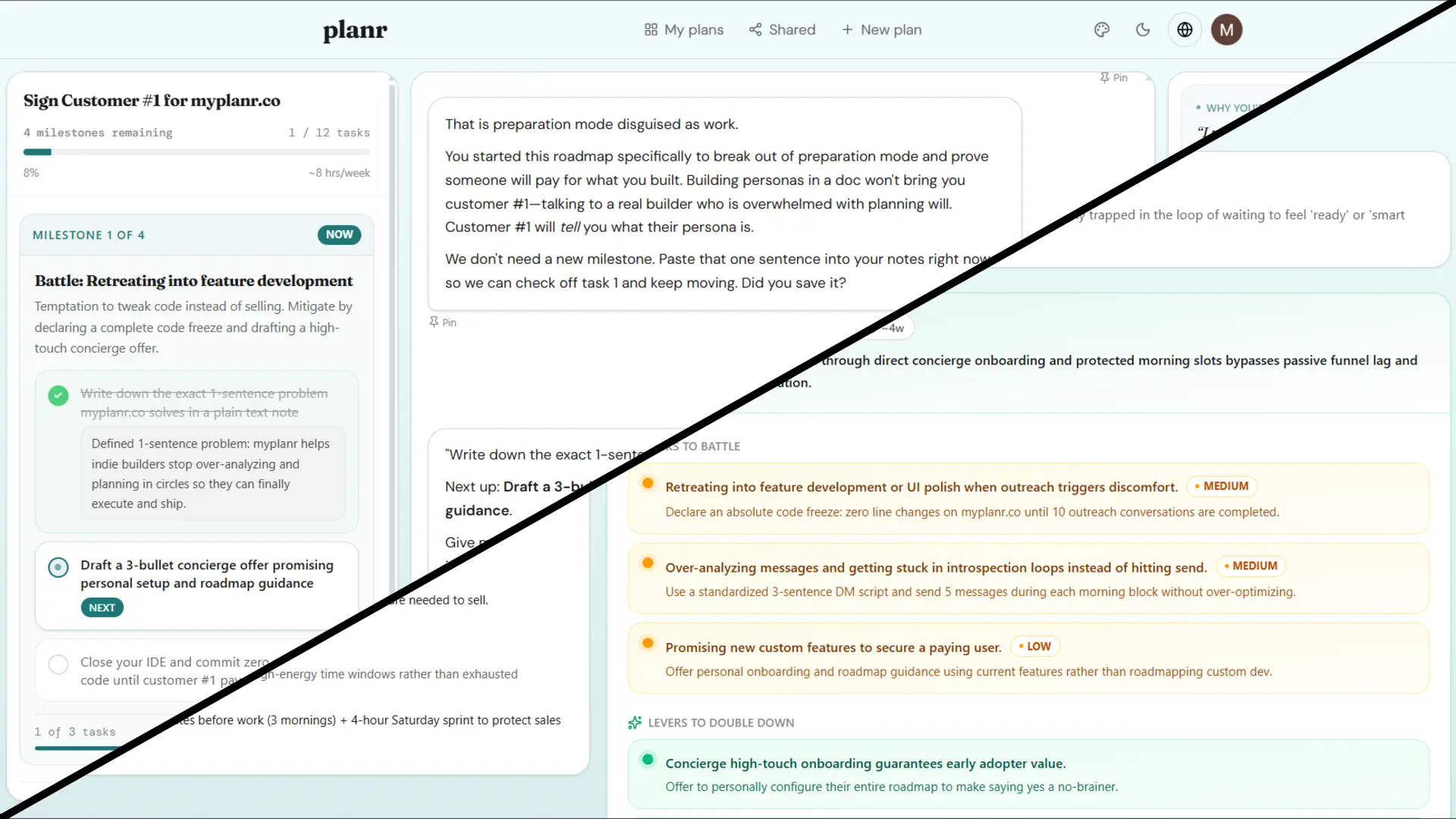
Planr treats change as part of the process. You can explain what happened, work through what it means for the goal, and figure out what should come next. The roadmap can adapt to your new circumstances instead of forcing you to throw everything away and start planning from scratch.
The goal isn't to create a plan that never changes. That simply isn't how life works.
The goal is to create a plan that can change without losing sight of where you're going.
Planning is only useful if it helps you execute
There is a point where planning stops being preparation and starts becoming procrastination. You can spend days researching the perfect approach, organizing your notes, comparing tools, and building increasingly detailed checklists. It feels like progress because you're doing something, but eventually you have to stop preparing and start doing the work.
Planr is designed to reduce the amount of time and effort spent figuring out what to do next, so more of your energy can go toward actually doing it. The plan provides structure, milestones provide direction, and tasks turn that direction into concrete actions you can work through.
And while you're executing, you don't have to treat the plan as something separate from the work. Planr stays available when you need help understanding what comes next or dealing with an obstacle along the way.
Your progress shouldn't disappear behind you
Long projects create another problem: context.
When you're on step 70, you might not remember exactly what happened on step 6. Why did you make that decision? What did you learn? What worked? What didn't? What changed?
Those details can become important when deciding what to do next. Over time, it's easy for all of those experiences to become scattered across notes, documents, messages, and conversations.
Planr keeps the context of your work as you move through the plan, so previous decisions and outcomes don't simply disappear behind you. The longer a project becomes and the more things happen along the way, the more valuable that context becomes.
Planr is live
Planr is now available at myplanr.co.
It's built for people who have something they want to accomplish but don't necessarily have a clear path from where they are now to where they want to be. You start with the goal, and Planr helps you understand what it requires, build a plan around your circumstances, and adapt that plan as those circumstances change.
Because the point of planning isn't to have a beautiful plan sitting on your screen.
It's to get from "I want to do this" to "I did it."
Share this article
See it on your own goal
Reading helps. A plan sized to your real life helps more — blank-page to roadmap in about 90 seconds.